Maxillofacial prosthetics
Auricular Prosthetics
Custom-crafted ear prostheses that restore a natural appearance and self-confidence following the loss or absence of an ear — individually sculpted and color-matched by Dr. Min S. Kim at our Washington clinics.
What is an auricular prosthesis?
An auricular prosthesis is a custom-made external ear prosthesis that replaces a missing or severely malformed ear. Fabricated from medical-grade silicone and hand-painted to match the patient's skin tone, surface texture, and the contours of the opposite ear, a well-crafted auricular prosthesis is remarkably lifelike and virtually undetectable in everyday settings.
Dr. Min S. Kim's dual credentials in maxillofacial prosthetics and prosthodontics, combined with in-house fabrication at our clinic lab, allow for the highest level of customization and quality control. Each prosthesis is sculpted, tinted, and fitted individually — ensuring the closest possible match to your natural anatomy and a secure, comfortable result.
Who needs an auricular prosthesis?
Microtia and congenital absence
Children and adults born with microtia (a small or malformed ear) or anotia (complete absence of the ear) can achieve a natural appearance with a custom auricular prosthesis, often as an alternative to or following reconstructive surgery.
Cancer surgery
Removal of the ear or surrounding tissue due to skin cancer, squamous cell carcinoma, or other malignancies can be rehabilitated with a prosthesis that restores appearance and protects the remaining tissue.
Traumatic ear loss
Accidents, burns, animal bites, or other injuries resulting in partial or total ear loss can be addressed with a custom auricular prosthesis that closely replicates the patient's natural ear.
Radiation necrosis
Tissue loss following radiation therapy for head and neck cancers can create auricular defects that are best addressed with a prosthetic solution, particularly when further surgery is not appropriate.
Failed or incomplete reconstruction
When surgical ear reconstruction has not achieved a satisfactory result, an auricular prosthesis provides a reliable, non-surgical path to improved appearance and patient satisfaction.
Partial ear defects
Loss of part of the ear — the helix, lobule, or antihelix — due to surgery, trauma, or disease can be addressed with a partial auricular prosthesis that blends seamlessly with the remaining natural tissue.
Retention options
Adhesive retention
Medical-grade skin adhesive is the most widely used retention method for auricular prostheses. It is non-surgical, reversible, and suitable for most patients. Dr. Kim will guide you on application technique and the best adhesive products for your skin type and activity level.
Osseointegrated implants
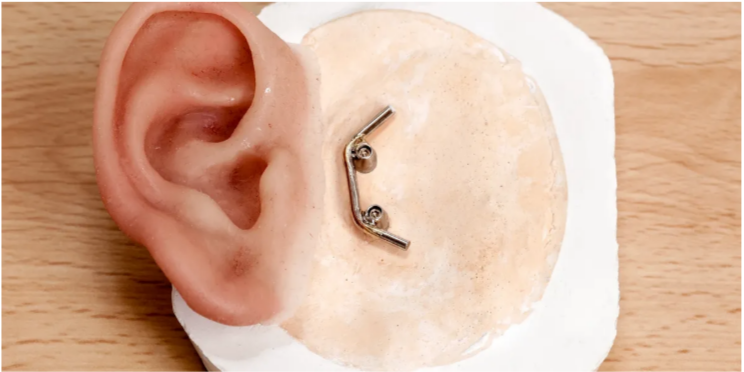
Titanium implants placed in the mastoid bone behind the ear can support a bar-and-clip or magnetic retention system, providing a highly secure fit without daily adhesive application. This option is ideal for patients with skin sensitivity or those who prefer a more convenient routine.
Eyeglass frame retention
For patients who wear glasses, the prosthesis can be designed to attach to or be supported by the eyeglass frame, providing additional stability and a natural appearance without the need for adhesive.
What an auricular prosthesis provides
Lifelike appearance
Hand-sculpted and individually tinted to match your skin tone, surface texture, and the contours of your opposite ear, a custom auricular prosthesis is virtually indistinguishable from a natural ear in everyday social settings.
Non-surgical solution
An auricular prosthesis achieves a natural result without the risks, recovery time, or limitations of complex reconstructive surgery — making it appropriate for patients of all ages and health statuses.
Hearing aid compatibility
Auricular prostheses can be designed to accommodate behind-the-ear or bone-anchored hearing aids, ensuring that patients with hearing loss can benefit from both prosthetic and audiological rehabilitation simultaneously.
Comfortable daily wear
Fabricated from lightweight, flexible medical-grade silicone and fitted precisely to your anatomy, a well-made auricular prosthesis can be worn comfortably throughout the day.
Psychological wellbeing
Restoring a natural ear appearance has a profound positive impact on confidence, social participation, and emotional wellbeing — particularly for children and adolescents navigating school and social environments.
Adjustable over time
As the patient's skin tone changes with age or sun exposure, the prosthesis can be remade or retinted to maintain the best possible color match. Retention systems can also be updated as needs change.
Your fitting journey
Consultation and assessment
Dr. Kim evaluates the auricular defect, skin condition, and retention options. For children with microtia, timing relative to growth and any planned surgery is discussed. Coordination with your surgeon or ENT specialist is arranged as needed.
Impressions and sculpting
Detailed impressions of the defect site and the opposite ear are taken. Dr. Kim sculpts a wax pattern that replicates the natural contours of the ear, refining the shape at the chairside until the fit and appearance are correct.
Fabrication and color matching
The prosthesis is fabricated in medical-grade silicone and individually tinted through its full depth to match your skin tone and surface detail. Subtle color variations, surface texture, and any visible veining are replicated for a lifelike result.
Fitting and retention setup
The prosthesis is placed and evaluated for fit, comfort, and appearance. Adhesive technique or implant-retained hardware is set up, and the patient is trained in daily application, removal, and care.
Follow-up and maintenance
Regular follow-up appointments monitor tissue health, prosthesis condition, and color match. Silicone prostheses are typically remade every 2–3 years as the material ages or as skin tone changes over time.
Frequently asked questions
About Dr. Min S. Kim
Maxillofacial Prosthetist/Denturist — King's College London — 40,000+ patients treated
Look like yourself again.
Whether you or your child needs an auricular prosthesis, our team is here to guide you through every step — from the first consultation to long-term care. Contact us at any of our three Washington locations.