Restorative dentistry
Flexible Combo Dentures
The best of both worlds — a flexible, metal-free partial denture combined with a precision framework for patients who need greater stability and coverage without sacrificing comfort or aesthetics.
When flexibility meets structural support
Flexible combo dentures combine the comfort and aesthetics of a flexible thermoplastic base with the structural reinforcement of a precision framework — ideal for patients who need to replace multiple missing teeth across different areas of the mouth, or who require more support than a standard flexible partial can provide on its own.
Dr. Min S. Kim designs each flexible combo denture to the patient's exact anatomy, balancing the soft, gum-colored flexibility of Valplast-style resin with a reinforced structure that distributes bite forces evenly. The result is a prosthetic that is more comfortable than a rigid cast partial, more stable than a standard flexible partial, and virtually invisible when you smile.
Who is a flexible combo denture right for?
Multiple missing teeth in different areas
Patients missing teeth in more than one zone of the arch benefit from the combo design's ability to span larger gaps while maintaining a comfortable, flexible fit.
Patients who want no visible metal
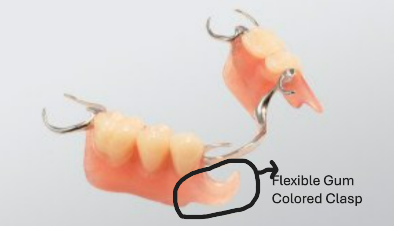
The flexible resin clasps and gum-colored base eliminate the visible metal components of a traditional cast partial, for a completely natural-looking result.
Those needing more stability than a standard flexible partial
The reinforced framework component provides greater bite stability and load distribution than a purely flexible partial, making it suitable for patients with more demanding chewing needs.
Patients with metal sensitivities
Because the clasps and base are made from biocompatible thermoplastic resin rather than metal alloys, flexible combo dentures are safe for patients with metal allergies or sensitivities.
Benefits of flexible combo dentures
No visible metal clasps
Gum-colored thermoplastic clasps blend seamlessly with your natural tissue for a completely discreet restoration.
Greater stability than standard flexible partials
The reinforced framework distributes chewing forces more evenly, providing a more secure fit for patients with larger or more complex tooth loss.
Comfortable and lightweight
The flexible resin base adapts to the natural contours of your mouth, reducing pressure points and making all-day wear more comfortable.
Biocompatible materials
No metal alloys means no risk of metal sensitivity reactions — suitable for patients who cannot tolerate traditional cast metal partials.
Natural aesthetics
Replacement teeth are matched to your existing smile in color and shape, and the gum-colored base blends with your natural tissue tone.
In-house lab craftsmanship
Fabricated in our on-site dental lab under Dr. Kim's direct oversight, ensuring precise fit and quality control at every step.
Your flexible combo denture journey
Consultation & planning
Dr. Kim evaluates your remaining teeth, bite, and the extent of tooth loss to determine whether a flexible combo denture is the optimal solution for your needs.
Digital impressions & measurements
Precise 3D scans capture your mouth's exact shape and bite relationship, forming the foundation for an accurately fitting prosthetic.
Framework & resin design
The structural framework and flexible resin components are designed together to ensure the finished denture balances stability with comfort.
Try-in appointment
A trial fitting lets you preview the look and feel before final fabrication, with any adjustments made before the denture is completed.
Delivery & follow-up care
Your finished flexible combo denture is delivered and fine-tuned for a comfortable, secure fit. Follow-up appointments are included to ensure long-term satisfaction.
Frequently asked questions
Find out if a flexible combo denture is right for you
Schedule a no-obligation consultation at any of our three locations. Dr. Kim will assess your needs and walk you through every option available.