
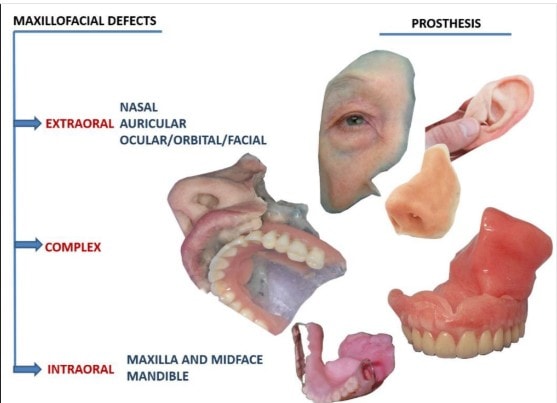
Maxillofacial prosthetics
Palatal Lift Prosthesis
A non-surgical solution for velopharyngeal insufficiency — restoring intelligible speech and safe swallowing for patients with palate weakness caused by neurological conditions, cleft palate, or head and neck surgery.
What is a palatal lift prosthesis?
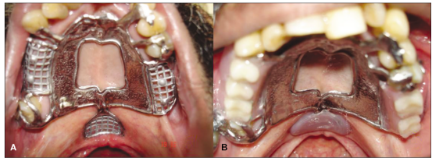
A palatal lift prosthesis is a custom removable oral device that mechanically elevates a weak or paralyzed soft palate (velum) to the level needed to close off the nasal passage during speech and swallowing. When the soft palate cannot rise on its own — due to neurological disease, stroke, traumatic brain injury, or surgical resection — air and sound escape into the nasal cavity, producing hypernasal speech and causing liquids or food to enter the nose.
Unlike a speech bulb obturator, which fills a gap in the palate, a palatal lift physically raises the existing soft palate tissue. Dr. Min S. Kim designs and fits each prosthesis individually, working closely with speech-language pathologists and the patient's medical team to achieve the best possible functional outcome.
Who benefits from a palatal lift?
Neurological conditions
Patients with ALS, multiple sclerosis, Parkinson's disease, or other motor neuron diseases that weaken the soft palate muscles often benefit significantly from palatal lift therapy.
Stroke and traumatic brain injury
Velopharyngeal weakness following stroke or TBI can cause hypernasal speech and swallowing difficulties that a palatal lift can address while neurological recovery continues.
Post-surgical palate weakness
Patients who have undergone surgery involving the soft palate, pharynx, or surrounding structures may develop velopharyngeal insufficiency that a palatal lift can compensate for.
Cleft palate — residual insufficiency
Some patients who have had cleft palate repair surgery retain residual velopharyngeal insufficiency. A palatal lift can provide functional improvement while avoiding additional surgery.
Myasthenia gravis
The fluctuating muscle weakness of myasthenia gravis can affect the soft palate. A palatal lift provides consistent mechanical support independent of muscle fatigue.
Degenerative neuromuscular disease
For patients with progressive conditions where surgical intervention is not appropriate, a palatal lift offers a reversible, adjustable, non-surgical path to improved communication and quality of life.
What a palatal lift restores
Intelligible speech
By closing the velopharyngeal port during speech, the prosthesis restores the oral pressure needed for consonant production and dramatically reduces hypernasal resonance.
Safer swallowing
Elevating the soft palate prevents nasal regurgitation of liquids and food, reducing aspiration risk and improving nutritional intake.
Non-surgical approach
A palatal lift achieves functional improvement without surgery, making it appropriate for patients who are not surgical candidates or who prefer a reversible option.
Adjustable and reversible
The prosthesis can be adjusted as the patient's condition changes — raised or lowered, relined, or discontinued — providing flexibility that surgical options cannot.
Complements speech therapy
Used alongside speech-language pathology, a palatal lift can accelerate functional gains and help patients achieve communication goals faster than therapy alone.
Improved quality of life
Restoring the ability to speak clearly and eat safely has a profound impact on social participation, independence, and emotional wellbeing for patients and their families.
Your treatment journey
Evaluation and candidacy assessment
Dr. Kim evaluates your oral anatomy, palate mobility, and dental status to determine whether a palatal lift is appropriate. Coordination with your neurologist, speech-language pathologist, or surgical team is arranged as needed.
Impressions and design
Precise impressions of your upper arch are taken to fabricate a custom-fitted palatal lift. The lift component is designed to raise the soft palate to the optimal height for velopharyngeal closure without causing discomfort or gagging.
Trial fitting and adjustment
The prosthesis is delivered and carefully adjusted at the chairside. The lift height is set incrementally — often over several appointments — to allow the palate and pharyngeal muscles to adapt gradually and minimize the gag reflex.
Speech therapy integration
Dr. Kim coordinates with your speech-language pathologist to assess speech and swallowing outcomes with the prosthesis in place, and to guide any further adjustments needed to optimize function.
Ongoing monitoring and maintenance
Regular follow-up appointments monitor fit, tissue health, and functional outcomes. The prosthesis is adjusted or relined as your anatomy or condition changes over time.
Frequently asked questions
About Dr. Min S. Kim
Maxillofacial Prosthetist/Denturist — King's College London — 40,000+ patients treated
Speak clearly. Swallow safely. Live fully.
If you or a loved one is living with velopharyngeal insufficiency, our team is ready to help. Contact us at any of our three Washington locations to schedule a consultation with Dr. Kim.